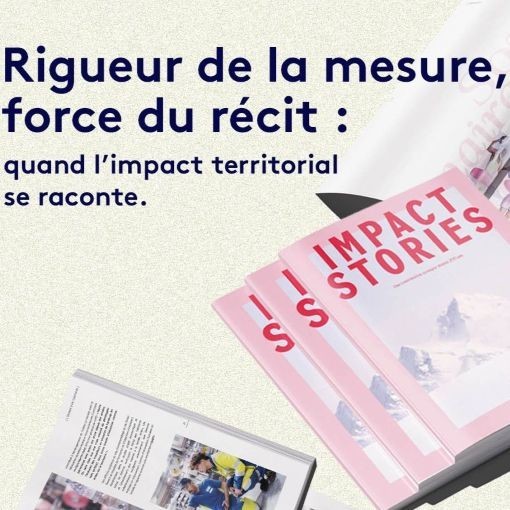
IMPACT STORIES Rigorous measurement, powerful storytelling: when territorial impact becomes a narrative
How does a brand deeply rooted in its local territory contribute to employment, supply chains, cooperation and regional attractiveness? What is the relationship between industrial activity and territorial impact? How can these contributions be measured precisely and communicated effectively ?
These are questions we care deeply about, and ones we had the opportunity to explore on the occasion of evian's 200th anniversary.
To mark its bicentenary, Danone entrusted us with a mission: to understand, measure and communicate Evian's contribution to its ecosystem, in order to better shape its future.
From this collaboration came Impact Stories, an editorial deliverable designed as a high-end magazine, published in two languages for an international audience of journalists, decision-makers and influencers. The project was also an opportunity to deploy our new socio-economic contribution analysis methodology, designed to measure with precision the economic effects of an industry's activities on its territory.
Concretely, we assessed the jobs supported by evian at several levels: direct jobs linked to its own operations, indirect jobs generated across its supplier network, and induced jobs created through employee spending and public expenditure made possible by taxes and contributions. This quantitative approach was enriched by in-depth qualitative work, drawing on interviews conducted with Danone teams and several key territorial partners.
At Archipel&Co, we believe in creating editorial objects where form serves substance. With Impact Stories, we sought to bring together the rigour of measurement and the power of storytelling.
Behind this format lies a conviction: when demanding analytical work takes shape in something beautiful and desirable, it stands a far greater chance of being read, shared and truly owned by its audience.
Many thanks to Danone for their trust, and to everyone who gave their time to make this study possible.
Download the publication to discover the full editorial piece